Grandpa Pharis was a tall and slender man who, with the aid of his cane, stood very erect. His movements were careful and creaky. When he turned his focus to anything not right in front of him, his entire upper body, as if locked together, would slowly rotate. Nonetheless, he did not groan as he moved. He seemed essentially free of complaints.
His face was weathered and lined by the time I knew him. I think he was always serious. Only once I saw him on the verge of something that could have been a smile — if he had forced it. I never heard him laugh.
Observing him, as grandchildren will do from an awed distance, I noticed he did not argue or offer disrespectful commentary in conversation with others. He did not interrupt people and appeared to wait patiently until they were finished. His responses, always brief, were offered then. He never cranked out woeful stories about how things were when he was a kid.
All these qualities set him apart. But the most remarkable trait was that he never spoke to me as if I was a child. I was a child, but he did not seem to think this changed anything for him. His tone was the same as he used with adults. Occasionally, he would use a word I did not understand. If I asked him to explain, he did so matter-of-factually.
But we all have our “things,” – judgments, baggage, assumptions — and I finally found one of his.
My family was having Sunday dinner and my grandfather was present. The fact that he was at our house was noteworthy. It hadn’t been long since my grandmother passed. When she was alive, they had stuck fast together at their home where I usually encountered him. With her gone, his children wrangled him out and about some.
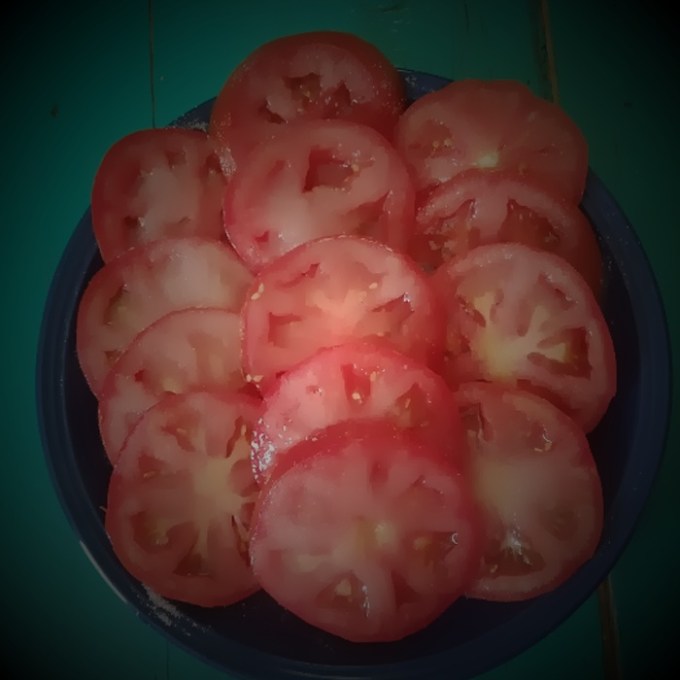
This Sunday’s dinner fare was not uncommon: fried chicken, mashed potatoes, green beans and a basket of biscuits. But then – as a final act before seating herself — my mother brought over a large platter of sliced tomatoes and placed them right in front of Grandpa. We had eaten tomatoes before, of course, but I had never seen such a heaping platter full. Equally puzzling, the platter was presented to Grandpa Pharis, as if it had the Thanksgiving turkey and he would be doing the honors of carving it.
He acknowledged the arrival of the platter with a nod. Then, Grandfather reached for the sugar bowl, took off the lid, and dusted the whole platter of tomatoes thick as a hard frost. Taking some for himself, he then passed the platter to his left. Everyone speared three or four slices and passed it on.
When it got to me, I just looked at the platter. I was perplexed. I had never seen or been offered such. Frankly, it looked disgusting.
I appealed directly to my Grandfather. “Papa,” I said. “I don’t want sugar on my tomatoes.” I was expecting him to give me a pass. I was disappointed.
Grandfather looked up sharply and drilled me with his eyes. With irritation in his voice, he said: “Boy, everybody likes sugar on their tomatoes.”
I was stunned. I blinked. I looked at the platter. It still looked pretty disgusting to me.
I looked over at my father to appeal my case, but that went nowhere. He just nodded his head and pointed toward the tomatoes with his fork. Now my father was fair and considerate about things, and he would usually not think a disliked food was something that a person should be forced to eat. Yet there he was, expecting me to do it. Essentially telling me I had to do it.
It was hopeless. I forked a slice onto my plate, and I managed to eat that tomato, sugar and all.
Grandpa Pharis will never know it, but there really is at least one person who has no interest in having sugar on their tomatoes.
- Note: Carlos made me wash the sugar off these before he would eat them. He is not kidding around. — Cyd Morgan, Photographer
 Carlos Declan Pharis