Fifteen Cents

Tom’s Store was right on the edge of town, where the dirt roads ended and paving appeared. It was a fair trek on foot.  Looking back, it seems remarkable that my mother would let me traipse off that far by myself. But truly, the worst that could happen was that I might come across a rattle snake, and I knew how to be wary of such critters. Occasionally a car or truck would come down the dirt road, and invariably it would be someone I knew. I thought I was hiking off to New York City.

The only thing that cast anything close to a shadow on going to Tom’s Store was dealing with Tom himself.

Tom was tall and thin. His face was craggy, lined and leathery. His hair was dark, wavy, flecked with gray, and he combed it straight back. He always reminded me a little bit of what I thought Abraham Lincoln’s evil twin brother would have looked like if he had had one.

Tom never smiled, never laughed, and absolutely never participated in small talk with kids. I observed him interacting with adult customers in his store from time to time, and his expression softened as he exchanged bits of conversation. I had long concluded that Tom thought childhood was a waste of time and ought to be skipped altogether.

His dour attitude became exceptionally apparent if a youngster came up to the counter to pay for something and was even a penny or two short. Now, if your parents had called ahead and authorized the purchase Tom would just ‘write it on the wall,’ as they used to say. Your folks would take care of it later.

But if you were a sprout buying what was clearly kid stuff, like a cola or a chocolate bar, well, then if you came up short, you just came up short. Tom wasn’t writing anything on the wall. Your soda went back in the cooler and the candy bar returned to the shelf. That was the end of the story. Very humiliating. I’d seen him do it. Consequently, I never went into the store without being certain I had the money to cover my purchase.

It was a small store. When you walked in the door, the check-out counter, behind which Tom was always seated, was to your left. After coming through the door, you could either walk straight ahead down the aisle that presented in front of you, or turn left, walk toward Tom a few steps, and turn right to pass down the one double shelf that ran the length of the store. In addition to Tom, the coolers lined the far-left side of the store.

A lot of my buddies would go in and proceed straight down the aisle in front of them. They would go all the way to the end of the store and double back around to the cooler. They would pick up their soda and then present themselves to Tom to pay out. This meant they had to deal with being close to Tom only once.

I could understand this. There was something about being real close to Tom that was intimidating. You could feel the beam of his eyes on you the whole time you were in the store. The closer you got, the more his eyes kind of made your insides jiggle. But he seemed to give the kids who avoided him an extra fierce and disdainful gaze that I didn’t like. He would tilt his head ever so slightly to the right as he watched them cut a wide berth around him.

On the other hand, when I came through that door, turned left, went straight toward him, and then turned right in front of him, he wouldn’t tilt his head to the side. He would just look straight at me and nod ever so slightly as I went by. I’m not saying it wasn’t scary, but it felt a little better. More respectful.

One day I walked through the front just like usual. The little bell attached to the top of the door jingled out an alert. He looked up and, predictable as the rising sun, fixed his eyes on me as I approached. I met his gaze. He nodded.

The issue occupying my mind at that moment was whether to add a Dreamsicle to my intended purchase of an RC Cola. I finally decided that the RC was enough. I was going to amble over to the park after my stop at Tom’s. Toting along an ice cream bar in one hand and a soda in the other seemed a challenge to my main goal: to look cool.

I put my soda on the counter and went for my change to pay up. Tom didn’t say a word. He knew that I knew how much the soda was. I got my coins out and handed them to him. He said, “Thank ya,” and hit the keys on the old register. The door popped open and he dropped in the money.

Suddenly, I got focused on a dime and a nickel laying out there on the edge of the counter, a little off to the side and out of Tom’s view. Fifteen whole cents!  In 1958, that was an amount worthy of some note. I was frozen with indecision for a moment.

When Tom looked up from closing the cash register, I was still standing there. He seemed a little surprised. And just like that, I knew what to do. I pointed with my index finger toward the coins.

“There’s some money there,” I said. “It isn’t mine.”

Tom leaned forward a bit and looked at the coins. Then he looked back at me.

“See ya,” I said, turned and went out the door.

The next little while, whenever I came in Tom’s Store, things were just like they always were, and he was just like he always was. Our exchanges at the counter were sparse and direct.

Finally, a day arrived when, despite my caution about never coming into the store without the necessary funds, I did just that. I got to the counter with an RC Cola and Snickers bar, put the items on the counter, reached in my pocket, and instead of encountering metal, found nothing but the soft cotton of my jeans pocket. Quickly I reached over into my left-hand pocket. I knew that was no use though. I would never put money there. I also checked my two back pockets and the pocket on my t-shirt. Nothing. Now I could see the money lying on the top of my chest of drawers.

I took a sigh, and collected the soda and the chocolate bar to return them to stock. Tom had been watching me as I went through all this pocket grubbing. “Change your mind?” he asked as I pulled the items towards me.

“No. Don’t have my money. Left it on the dresser.”  I now had the soda in one hand and the Snickers in the other. I was a couple of paces from the counter headed back for the cooler and the candy case.

“Hold on there,” Tom commanded. I froze. “It’s pretty hot out there. You look a little wilted. Go ahead and take that soda. The candy too. Give you a little energy.”

I turned and stared at him dumbfounded. “But I don’t have any money with me,” I stammered.

“I heard you.” And he scowled a little. “You owe me 27 cents. Bring it by next time you come down the road.”


Interesting

Encyclopedia Blurred

I was sitting at the dining room table munching on my after-school snack when I noticed a collection of boxes sitting just inside the front door against the wall.

My mother looked up from the kitchen and caught my gaze. “You looking at those boxes?”

I allowed that I was.

“Just something your Daddy ordered,” she said. She waved her hand dismissively and moved on, opening the refrigerator to get something.

I puzzled on the mystery of what was in those boxes. After a minute or so, my Mom left the kitchen. I seized the unsupervised moment to hop down from my perch at the table and inspect the cartons.

The boxes were made of thick cardboard. They were heavy. I tried to push one with my foot and it didn’t budge. Unusual.

I felt my Mom’s gaze. She was standing in the dining area looking at me with a dish towel in her hand. “You through with this?” she asked, pointing at the barely nibbled snack and the half empty glass of milk I had left on the table.

“Yes, ma’am” I said.

“Then get it on to the kitchen” she commanded. “And stop fidgeting about those books.”

She started back toward the kitchen.

“Books?” I exclaimed. “What kind of books?”

“It doesn’t matter a lick,” she threw over her shoulder. “They’re your Daddy’s business and they don’t concern you or me.”

As I settled at the breakfast table the next morning, my father cleared his throat and produced a good-sized brown book from his lap. He opened it up, considered the page, and pronounced with some gravity “Aardvark.”

My mother stopped dishing food. “Bill, if we are going to read at breakfast it ought to be something from the Bible.”

He gazed at her with a pleasant expression over the top of the big brown book he held open in his hand. “Darling, we have a preacher that is paid, not well, but paid to teach us from the Good Book. I’ll wager…. well, maybe I shouldn’t bet on it…. but I am thinking that he is better trained to direct our religious education than I am.”

He said this with an air of satisfaction and returned his gaze to the book. It was clear to me that he felt the issue settled.

I looked at my mother to see what her take would be.

“Excuse me,” she said flatly. “I’ll be feeding the boy and myself. We’ll save you some for when you are through holding your encyclopedia class.” She proceeded to load my plate with scrambled eggs, bacon, and biscuits slathered with a big ladle of red-eye gravy.

My father seemed content with this and proceeded once again: “Aardvark.” When he was through reading the entry he closed the book, looked at me and said, “Now that was interesting.”

Dad gathered up his food, and the two of us proceeded to eat. Mother was ahead, but we caught up quickly.

Thereafter, an encyclopedia reading was added to our morning routine. And it was, just as he declared, interesting.


Hammered Toe

At the time, I was a very small tyke, just walking and speaking. There was a uniform of the day I no doubt had on: a jumper that buttons up on the shoulders, maybe with a little t-shirt underneath. The sartorial package came with a cotton diaper and plastic wrapper that created a big bulge all around my bottom. It was completed with a pair of little white lace-up shoes that my mother polished freshly every day.

The eye-witness report of these events comes courtesy of my Grandmother Vinnie, who was there with us for one of her extended stays. She was sitting in the living room and watched the scene unfold.

My Dad entered the living room, intent on connecting with the newspaper and his cup of coffee. Upon sitting, he liked to get out of his shoes and into a pair of house slippers. Sometimes, especially in the summer, the house slippers did not get on for a while. They just sat there beside his feet while he drank his coffee and read the paper. Above all, he was not to be disturbed.

Enter me.

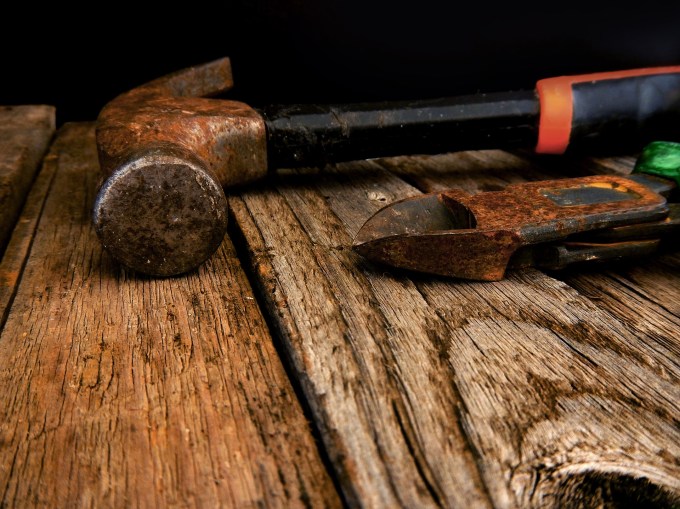
I acquired his hammer from where he had left it with all his other tools at the back door – a common place for him to drop them on his way in. Given that adults in my life only intervened on my activities if I was going to hurt myself, no one paid much attention to me dragging my Dad’s hammer about the place.

Eventually, I approached my Father, and announced rather matter-of-factly: “Daddy, I’m gonna hammer.”  To this piece of information, he responded with the kind of parental grunt given children when an audible response is called for but the energy or interest to get meaningfully involved is missing.

I looked around for something to hammer. With my one free hand, the other being used to hold my trusty tool, I patted my Father’s knee, disturbing his paper only the slightest. I asked with the kind of rational tone only a child can use when asking a completely bizarre question: “Can I hit your toe with this hammer?”

Now look, I don’t have a clue as to why, among all the things in the room I might have chosen to take a whack at, his toe represented to me the most likely candidate. A Freudian analyst would blather something about my sense that I had taken back seat to the news of Lea County and that I wanted to reassert my position as the only appropriate object of affection.  When I asked my Grandmother about it years later, she simply said: “Well, you know, little children do things like that.”

At any rate, it did register on my Father that a question had been posed to him.  He made one feeble attempt to join the conversation.  “What son?” he mumbled from behind his paper.

“Can I hit your toe with this hammer?” I repeated.

It is at this moment he made the error parents have been making in similar situations for years untold. Truthfully, he just wanted me to leave him alone, so he could go on reading the paper. His cup of coffee had been thoughtfully refilled by my Grandmother and he was fully engaged in the news. And so, he said, “Sure. Sure, son.”

I’m sure some of you are wondering why Grandmother didn’t intervene. I asked her myself. To her mind, the conversation between my father and me did not concern her in the least. The child was not in danger, and surely a man who had fought Hitler’s SS Units in Europe was not threatened to any great degree by a little boy barely able to walk, even if he was dragging a hammer behind him.

Having requested and been given permission to strike my Father’s toe with the hammer, I grasped it with my two chubby hands, lifted it, and let it go. Gravity did most of the work from there. And the head of that hammer hit his toe as precisely as my mother threading a sewing needle.

My Father bolted out of his chair like he had been shot with electricity. The coffee cup flew to his left and the paper rained down across the living room. He made loud and quite unintelligible sounds. (My mother seemed to have understood some of the words because I heard her later tell him he shouldn’t use such language in front of me.)  He hopped around a bit, which I thought was funny.

My Father did not think any of this was funny. When the pain subsided some and he got composed a bit, he made a grab for me. It was at this point my Grandmother concluded that she had a legitimate reason to be involved.

Grandmother leaned forward in her chair and said in an assertive voice: “Bill.” She had to repeat herself because my Father had a serious head of steam built up. “Bill!” she said again a little louder.

He stopped and looked straight at her. He had me dangling from one arm, with the offending hammer laying just out of my reach on the floor.  He gave my Grandmother direct attention.

“Bill,” she said, in a gentler tone now, “you told the boy he could do that.”

His gaze was incredulous.

“The child asked if he could hit your toe with that hammer.”  She pointed toward the carpentry implement that I was still eyeing.  “And you told him it was ok.”

“Well,” he blustered out and then let it trail off.  Finally, he said, “Well, Lord, I didn’t mean it.”

He let me back onto the floor. I sat down on my fully cushioned rump and began to handle the hammer with both hands.

My Father stepped away a couple of feet.  “I guess I wasn’t really listening to him.” He peered at Grandmother hopefully.  “I mean, did he really ask me?”

“I’m afraid so,” she said.  “I’m afraid so.”

The damage to his toe was not permanent, but the incident changed the way we communicated forever.  From then on, whenever I posed a question or wanted his attention in any way while he was having his alone time, the paper came down from his face immediately.

“Yes, Son?” he would say, and gaze at me intently.

Children Dancing

Dancing with Angela

If I had been on my toes, I would have known that a dust up with my mother was just over the horizon. She had a very tight focus when it came to the child she was rearing: my actions needed to burnish her reputation as a mother. Accordingly, she was sensitive to the perceptions of others, and I should have known she would give serious attention to this latest adventure.

I suppose it didn’t help that Mescalero Hills was a small place. News traveled fast and consensus formed quickly. For example, suppose a fellow opted for coffee with his lunch at Polly’s Chuck Wagon as opposed to his usual lemonade. His wife might easily have wind of it before the waitress was back around to offer him a warm up. Many in the cafe would take note. Questions would be sparked: Why was Dolph drinking coffee at noon rather than his lemonade? Was this a change-of-taste issue or was there a darker answer? Perhaps he needed a boost of energy because he was slipping around on his wife. After all, Janet Hubley had just finished up her divorce and was angling for a man. By the time Dolph got home, half the little burg could be certain that he was moving out and shacking up with Janet.

So, my mother’s ear was always to the ground and her nose in the wind, vigilant for anything that might threaten her reputation as the perfect mother. I was not concerned about such.

At this particular time, I was even less concerned than usual. I was preoccupied by what I deemed a higher calling. The baseball World Series was underway. Baseball was pretty much the chief concern of my life, and the World Series was Christmas, birthday and summer vacation all rolled into one.

The 1958 World Series had even more of my attention than you would expect. The competing teams were the New York Yankees and the Milwaukee Braves. The ’58 Series was a rematch of the ’57 Series, and the Braves had given the Yanks a good shin kicking in ’57.

The Yanks came to the ’58 Series with their pride on the line. Here was their chance, not just to regain the World Championship but to get even with the Braves. There was a lot on the line for me too. I was a serious Yankee fan. Everyone who knew me was well aware of this. I had taken a ribbing the previous year when the mighty Yanks failed to come through.

The Series did not crank up well for Casey Stengel and company. Going into Game Five, New York was down three games to one. The last time a team had come back from such a deficit to win a series was 1925. In order to win the series, New York would have to win the next three games in a row. Not that I would have admitted this publicly, but that would be quite a feat against the Braves. They were amply supplied with talent and highly motivated to bloody the nose of the Mighty Bronx Bombers two years in a row.

The crucial Game Five was played on a Monday. All I was concerned about was the game. Our principal gave us updates over the PA system once the game got underway. I did not even take a breath until the sixth inning when the Yanks scored six runs and seemed pretty assured of winning the game.

With the game headed into the final innings and the Yanks comfortably in the lead, I begun to pull my head up and get conscious with what was happening in my classroom. I realized that my teacher was talking about the oral geography reports that were scheduled to be given that day. I had forgotten all about it. I had been assigned to report on Greenland. If I had to march to the front of the room and deliver the report it would be deemed by Mrs. Pugh as woefully lacking in substance.

I listened intently. Mrs. Pugh was saying there would be a change in our schedule for the day. She explained that the Activities portion of class was going to run longer than usual and the geography reports would be delayed a day. With the threat of immediate humiliation lifted from me, I just barely listened to her explanation about why Activities was expected to run over time. We were going to start a unit on square dance, and there were logistical issues to be addressed. Assigning dance partners was one.

That suited me just fine. Anything was more welcome than the menace of trying to ad lib my way through a report on Greenland.

I would like to report that I used this reprieve wisely and got my report done that night. I didn’t. With the outcome of the Series still in question, responsible problem-solving was beyond me. At any rate, back to our tale.

When I was a third grader I was unsophisticated regarding social politics. I took it literally when the teacher said that she would assign square dance partners. Truthfully she did not so much assign partners as ratify the selections that had already been made.  Thus, through one machination or another, most of the pairing had been accomplished before we gathered at the back of the room.

I probably had the personality to get myself attached to someone in these circumstances, but, as usual, I did not know that such a process was afoot. What I was clear about was that in the end there was a predictable outcome to any activity that involved pairing or teaming up: a residuum of misfits and persona non-grata remained for the teacher to sort out.

I was frequently left with this little cluster of the dispossessed. I was sharp enough to notice that there were some benefits to this situation: I met a lot of interesting people. I was not seen as a snob. The kids on the margins liked me. Teachers knew they could count on me in a crunch. In this particular moment my third grade teacher had a crunch on her hands.

Washington D.C. was a long way distant from the Llano Estacado both in miles and emotion. But inevitably the wave of change set off by Brown vs. Board of Education made its way to us. Mescalero Hills had integrated its schools in 1956, and everything had gone relatively smoothly. However, there was still some risk for public toe stubbing over the issue.

And this brings us back to Square Dancing.

In the end there were two boys and one girl who remained without partners. The other boy was a lad named Delbert. He had multiple social and behavioral challenges. He was typically dealt with by being designated as some unofficial assistant to the teacher. After Delbert was factored out, there was only Angela and me.

Up until that moment I did not know much about Angela. That she was a girl was the most significant fact. No hint of puberty had as of yet ruffled the waters of my life. Girls held no hormonal or emotional appeal for me.

Girls were just facts of life that to be accounted for. For instance, you could not hit a girl without expecting serious sanction from your parents and other authorities. They couldn’t throw, and thus were essentially worthless for baseball. They didn’t like to play army. They giggled too much. I frankly could not reason that they were of much use. I was disinterested.

Square dancing did not appeal to me either, except for the brief moment it had gotten me off the hook for the Greenland assignment. However, this was a school activity, and Mrs. Pugh knew I wouldn’t kick up a fuss. When I was instructed to stand by Angela, I moved to her side very agreeably.

Now we all stood beside our partners (except for Delbert, who had to stand right next to Mrs. Pugh!) while she read  from the instruction sheet that would go home to our parents about issues such as shoes.

Over the next few weeks we learned some of the rudimentary aspects and moves in square dancing. A great deal of the technical aspects of square dancing have faded with time. That’s not surprising since more than half a century has passed. But, I still remember four things crystal clear about Angela. One, she had the most beautiful and ready smile I had ever encountered. Two, she loved to dance. Three, she was real good at it. Four, with her as my partner, I learned a few hot moves myself.

It wasn’t long before Carlos and Angela started getting called out to demonstrate new steps Mrs. Pugh was teaching the class. I am not saying that Angela and I were the new Fred Astaire and Ginger Rogers, but we were good. We had fun. We liked each other.

Maybe that’s where the trouble really started.

At my elementary school, we had a number of Arts Assemblies each year. These were occasions when the whole school was in attendance along with a good number of parents. A collection of performances from the choir, the rhythm band, the drama club and gymnastics were typical.

I had never been a participant in these assemblies. Baseball was not on the play bill. Usually all that Arts Assembly meant to me was a Friday afternoon out of class and early dismissal.

This year was different.

Mrs. Pugh’s square dance class was to appear at the next Arts Assembly, and things had evolved in such a way that Angela and I had a little piece of our own to perform. You would have thought I was in a show that was about to open on Broadway. I never missed rehearsal and was always enthusiastic. Angela and I tended to our number as if our whole lives depended on it.

Lord, it was fun to dance with Angela!

Several times in the run up the the performance, Angela and I rehearsed our piece at the far edge of the square ball court at recess or even after school. Our delight in the activity and one another had been evident to everyone in class. Now that we were rehearsing outside, it was getting public exposure as well.

One night at supper I became aware that my mother was in “one of her moods.” These periodic storms were awful. They always began with silence and a scowl. I would do my best to steer clear of her. Sometimes these episodes of foul emotional weather had nothing to do with me.

When the issue was me, the storm would break in one of two ways. If it was a low level problem, it would be my mother who would eventually raise the concern with me. The good news about this was that she would generate a big verbal dust up, then go silent, hold a grudge for a few days, and the whole thing would dissipate. On the other hand, if the problem that set her off was something above a misdemeanor level, it would wind up in my dad’s court. The good news here was that my dad was unfailingly courteous and generally as fair as you could expect a fallible human to be. The bad news was the issue was of some gravity.

Tonight we were in the superior court.

The process began with my mother clearing her throat and casting a sour glance at my father. He appeared to be completely unaware of this gesture for a long moment or two.  Then he looked at me with a very neutral expression and asked, as he continued to cut his meat, “I hear you are learning to square dance?”

“Yes, sir, I am,” I said and smiled like a loon. You remember I told you that I had come to be tickled pink with the whole process.

As I answered, he watched me carefully and took a small piece of meat in his mouth off the end of his fork. “I was never any good at square dancing,” he said. “But I like to watch it.”

We ate in silence.

He spoke again after a bit. “Someone told me you cut a fine figure at it, that they had seen you practicing. Actually I guess ya’ll say ‘rehearsing’?” He looked at me quizzically.

“Yes, sir, rehearsing,” I said, smiling. “I guess I’m decent.”

He was quiet again. He had this marvelous conversational technique that almost always insured that you would go on and say more. It was a kind of attentive silence. You knew he was interested by his demeanor and the cast of his eyes. He didn’t say a word, but his countenance beckoned.

“There’s going to be an assembly,” I said. “My class is going to be in it.”

“Yes, indeed,” my mother said coldly, speaking for the first time. “There is going to be an assembly.”

My father and I stopped, turned toward her, and he gazed at her a moment. It was an evil tone if I ever heard one.

“I saw the flyer,” my Dad said. “I’ll be there.”

He was one of those dads who was always there unless he was traveling, which his work demanded occasionally. I was pleased to hear he’d be there, and a smile spread across my face.

But my mother just said in a caustic tone, “Oh yes, everyone is going to be there.”

My father did not even look up at her this time.

You could tell when things irritated him with respect to my mother. With some couples irritating remarks provoke looks and retorts. The more provoking, the more engagement. With my dad it was just the opposite. It was not so much that he ignored her. What my dad did was more a simple recognition that she was speaking. He offered a slight nod of his head toward her, coupled with a silence that spoke volumes regarding his disapproval or sense that her remarks were not helpful.

It was clear now that mother was headed toward a blow up.  But I wanted to say my piece before the storm broke full.

“I’m dancing a special number… me and my partner. We have a special routine we do,” I said with enthusiasm.

“Oh?” he said. “I sure want to hear about that.”

“We sure do,” mother said with a tone dripping with venom.

Now she had gone too far.

My dad looked straight at her and said: “Mother, we’re just having a pleasant conversation here about square dancing.” And then, “I sure would like to have some more of that corn bread if you have some over there on the stove.” My mother got up from the table and moved from the dining room into the kitchen for the cornbread without a word.

My dad turned his attention to me.  “Tell me about this special number,” he said.

Well, once started I went on and on like a drunk man. Who knows what all I said. I do remember that I described what Angela and I were going to do in great detail, about the music, and what everyone else was going to be doing while we would be in the spotlight.

He listened and smiled. “Well, I don’t want to miss that show.” He meant it. He never said anything like that casually. He offered a thank you for the cornbread my mother had brought back.

“Tell me about your partner, about Angela,” he suggested.  “I don’t believe I know her.”

I told you earlier that in those days I was a little slow when it it came to social politics. As incredible as it seems now, I thought my mother’s snootiness had something to do with a disdain for square dancing. Finally, it flashed in my mind that the real issue was not square dancing, but who I was dancing with.

“You say her name is Angela?” my dad said gently.

I smiled.

“Tell me about her,” he said.

I said she was a dynamite partner and I liked dancing with her. I remember saying she liked knock-knock jokes, was good at arithmetic, and had helped me some with homework a couple of times. I reported that her Father was a Yankees fan too, just like me. I had met him once when he came to pick her up at school and we had talked a minute.

My dad was not a Yankees fan. He just didn’t like them. I never knew why.

He said at last, “Yankees fans are a little scarce around here. I guess you ought to keep track of Angela’s father given you investment in those New York boys.”

Then he smiled at me, and I smiled back. I kept waiting for him to say something about the fact that Angela was Black, but he didn’t. The conversation went on to this and that. Dessert came out. Pecan pie.

Near the end, right before it was time to clear the table, my dad tilted his head and looked at me.

“Son, did you pick Angela as your partner?”

“No, I didn’t,” I said.

He looked at me in that gentle but attentive way.

“The two of us were all that was left, except Delbert, and you know…..”

“I know,” he said. “Delbert isn’t going to match up easily.”

I nodded. I looked him square in the eye. I knew what he was trying to determine.

“I like Angela,” I said.”Nobody made me dance with her.”

He didn’t hesitate. He didn’t glance at my mother. He said firmly to me: “And nobody is going to stop you from dancing with her either.”

That was the end of it.

Except, my ego will not let me end without a report on the Assembly. It came off well. I am not exaggerating to say that Angela and I pretty nearly stole the show. We were good. It was a lot of fun. I am sorry you missed it.




Madrid New Mexico

The Windmill

The view was breathtaking. To the west was our little hardscrabble oil and ranching community. To the east was the vast expanse of the sourthern edge of the Llano Estacado. Above and all around was a luminous aqua sky dotted with white puffy clouds. The air was clean and light as a feather.

I was five years old. I had climbed up to the platform atop the windmill at the back of our property. I really don’t know how I managed this.

There was a two-lane paved road that led east in Texas. I could see it inch its way along until it seemed to over the edge of the earth. There was little traffic. I would occasionally see a car or two and sometimes a truck coming toward town or leaving. The vehicles looked like ants moving in their orderly and busy way.

Back toward town there was a black top road that ran toward me. The paving expired before it got to our place, finishing as a dirt road.

Eventually a particular vehicle caught my attention. It was still far away, but I could tell that it was Dad’s truck. It was coming my way.

Mild curiousity floated across my mind. What was he doing? Was he coming home? Why?

And then he was there. He turned onto our property, drove the short distance up the unpaved trace, parked and got out. He didn’t seem in any hurry, and he didn’t head into the house. As a matter of fact, he did what he did most times when he came home from work.

He ambled around the backyard, where he and my Mom were working to encourage grass to make a stand against the sand and weeds that thought the land belonged to them.

He took his pocketknife and dug up the roots of the big grass burrs that proliferated. He would walk around cutting these things out of the ground, holding them carefully in his left hand until he had a kind of grass burr bouquet. Then he would go over and deposit them in the trash can at the back of the property.

He would return to work until he had another collection in his hand. This would go on for 30 minutes or so. It was a kind of decompression ritual. When he was finished he would go inside where my Mom would meet him with a cup of coffee.

But that is what he did at the end of the day. Here we were, a long way before noon, and I was peering down watching him digging grass burrs just like he did in the evenings.

I was puzzled. I sat on the edge of the platform at the top of the windmill watching my Dad as he moved quietly and deliberately. This was very interesting because I had never seen this activity from such a height or perspective.

I didn’t call down to him, and he didn’t seem to know I was there. Eventually, though, he looked up at me. “Well, hi, Shorty,” he said, a bit surprised.

Then his head went bacck down and he went on with his work. My attention moved back and forth between my Dad and the broad vista around me. I was torn: I always wanted to be with my father, but the view was fantastic. I’d never seen anything like it.

Dad began to gather a little bit of trash and some twigs to add to the barrel where the grass burrs were being collected. From time-to-time he would burn all the refuse, and I would ‘help’ by going around the yard and picking up other miscellaneous items as he tended the fire.

When I realized where this process was going, I swung my leg over the platform onto the first rung and started down. A fire was the final incentive.

He seemed to hardly notice that I had climbed down the windmill. He just went about getting the fire started in the barrel. I started picking up random twigs, and an old brown paper sack that had blown into the yard.

Wordlessly, I walked up to heave the items into the fire. I waited for his go ahead as usual. Fire safety was an important lesson I had learned.

“Toss it in from over there,” he said, gesturing toward the north side of the barrel so that I would be up wind of the flames.

As I was doing this, he stepped over to the ladder that ran up the entire length of the windmill. He reached up, and with his hand struck the inside of the 1″x12″ that served as a rung. Off it came. He followed suit until all the steps on the ladder were gone up to the top of his head.

He took the pieces of wood that had served as rungs and stacked them together. He had dismantled the low end of the ladder discreetly but quickly. And tending to the fire was consuming my attention.

“We’ll let that fire die down. I just wanted those grass burrs to get burned up,” he said, gesturing toward the fire. “Let’s get a hammer and get these nails out of these boards. This is good wood. We can use it for something else.”

When we were finished, the wood was stacked neatly inside the shed. The nails we had removed were separated into two small piles. One pile contained the handful of nails that were straight enough or could be straightened for reuse. The others were set aside to be discarded altogether.

Sandstorm

I was sitting on the floor looking up at my mother. She was standing in front of the kitchen sink wringing out a wash rag from a pan of water. She bent down and started wiping my face, digging into my ears and nose with the cloth.

I pulled back a bit. She was sure tending to her cleaning chore with a lot of energy.

“Hold still,” she said. “You’ve got enough of the Llano Estacado in your nose and ears to grow a small garden. You wouldn’t want a tomato plant to start growing  out of your ear would you?”

“No, Momma, I wouldn’t,” I said, completely horrified by the thought.

I looked over her shoulder as she resumed working on me. We were in the middle of a sandstorm. The sun was high, but the sand was so thick the sun didn’t so much stream through the kitchen window as ooze through it. The light was a dull yellow. I could hear the wind whistling around the window and the sand pelting against the house.

The sand hung in tiny particles in the air in the kitchen. It was still inside the house and a bit stifling.

Satisfied that I was momentarily safe from being the breeding ground for vegetation, my Mom stepped back and rinsed out the rag. Then she bent down and folded the cloth over several times.

“I know it’s pretty close to wet,” she said. “But hold it over your mouth and nose and breath through it. It’ll keep the sand out of your lungs.”

She smiled and left me on the floor, returning to her work at the sink.

I held the cloth to my face and breathed through it. It did keep the sand out. It was cool and soothing.