
The Things We Do for Love

Dolph glanced up at the rear-view mirror.

“Is he back there again?” asked Eugene.

“It’s not the same vehicle, but he came out of the same spot behind the station,” replied Dolph. “I reckon he is either on the same team or he’s got a different set of wheels.”

The two-lane road into Hot Springs offered a lot of curves and a lot of ups and downs as it worked its way through the Ouachita Mountains. Dolph maintained a steady, safe speed as he drove the truck. He kept an eye on the mirror.

The car that had pulled from beside the Sinclair station at Cedar Creek Bridge stayed back a discreet distance. The headlights would disappear with a twist in the road, but they always reappeared when the road straightened out.

Eugene leaned forward to look in the side mirror. “Eugene, I’m watching him,” Dolph said.

The comment went right past Eugene. “Seems like he’s laying back further than usual. Maybe he’s not the guy who’s been tailing us.”

Dolph sighed. “Or maybe after following us into town several times, he knows where we are going.”

Eugene grunted and fell into silence for a mile or two. “Well,” he said presently, “we do make the same rendezvous right regular.”

“Yes, we do,” Dolph said. “Yes. We do.”

The next week Eugene scooted around in his seat like he had ants in his britches as they neared Cedar Creek. After they passed the Sinclair Station and crossed the bridge, Dolph checked the mirror.

Eugene looked at Dolph. Dolph drove on in silence. “Well,” Eugene half barked, “is he back there?”

“He is not,” Dolph said quietly.

“You don’t seem very pleased,” Eugene said with a condescending tone. Dolph just kept silently guiding the truck down the highway. “I just thought you’d be a little more pleased with being out of the woods on this deal,” he sulked.

Dolph glanced at Eugene. “Eugene, it’s not certain we are out of the woods,” he said. Eugene got a puzzled expression on his face. “He does not have to tail us, Eugene.”

“Yeah?”

“Yeah. He knows where we are going. He’s there right now.”

Eugene didn’t say a word the rest of the way into town. Dolph pulled the old International into a spot across the street from their destination.

“Why are we parking over here?” Eugene asked.

“Just sit still,” said Dolph. “Have a smoke. Look around.”

Eugene was about halfway through his Camel when he leaned forward and squinted. “Sweet Honeycutt Blossom,” he said quietly. “There he is, Dolph. Do you see him? That car there with its nose sticking out between the jewelry store and the hat shop?”

“Yep, I see,” Dolph answered.

“We’ve seen that car before.”

“Oh, we have indeed,” said Dolph, and hauled himself out of the truck. Making their way across the street, Dolph pondered on why in the world anyone would be tailing them.

It wasn’t a week before Deanna and Joann called a meeting with their husbands.

“Our detective says the two of you are going to the Crystal Dance Academy down on Central Avenue every Tuesday night,” said Deanna sternly.

Eugene burst into a huge smile and sucked in a lung full of air to respond. His wife cut him off before he could speak. “Shut up, Eugene,” Joann said. “We want to hear from the brains of this outfit.” With that, both Joann and Deanna turned their withering gazes on Dolph.

“Me?” Dolph asked with feigned surprise.

Deanna cleared her throat and proceeded. “Dolph, we’ve been married for 17 years. This mess has your fingerprints all over it.”

And so Dolph was forced to explain the whole situation. It all started with wanting to surprise the ladies on their upcoming anniversaries and searching a long time for dance lessons. Then, it had devolved into lots of lying and covering up so that they both could get away for the considerable and regular time required. “It was supposed to be romantic,” he explained defensively, “something you ladies have frequently said we are not.”

Later that very night, dinner was as silent as a funeral. Dolph and Deanna moved out to the porch after the dishes were cleared. They did this every night. Usually there was congenial talk about the proceedings of the day. Not tonight. The crickets and the gentle squeaking of the porch swing were the only sounds.

Dolph wanted to compliment Deanna’s fried chicken, but he was afraid to. Being perceived as trying to suck up in the wake of this fiasco was not what he was hankering for. When he finally did speak, he left the chicken out of the conversation.

“I really did wrong, Deanna. The whole thing was just….”

“Wait,” Deanna cut in. “We need to be clear. Only part of the deal was stinky as fresh cow plop. The other part was sweet as roses.”

Dolph was confused but felt a glimmer of hope. “Can you sort that out for me?”

“Husband, it is the sweetest thing in the world that you boys want to take your wives out dancing proper.” Here, Dolph nodded cautiously, while Deanna continued. “And it is true that neither you nor Eugene have much skill on the dance floor. I have never danced with Eugene, but I believe Joann’s report regarding the danger his clomping around exposes to those close by. Going to the trouble and expense to get some professional instruction is going above and beyond the call of duty.”

She gave Dolph the smile that always melted his heart. “But here is the other part.” Dolph noted her smile faded. “You should not have hidden what you were doing,” Deanna said firmly. “You boys worried us grievously.”

Her tone softened. “Dolph,” she said, leaning towards him. “I thought I was losing you.”

“Losing me?!” Dolph was startled.

“Well, yes,” she said with a pained expression. “I thought you were slipping off to see some barfly down to Hot Springs.”

“Oh, Deanna….” Dolph said, pained now too. “I never thought such. There has never, ever, never been anyone but you.”

They looked at each other in silence. Then the smile began to spread slowly across Deanna’s face again. “I know, Dolph.”

Dolph scooted closer. “I’m gonna kiss you, girl.”

“You better,” Deanna replied.

© 2020 Carlos Declan Pharis
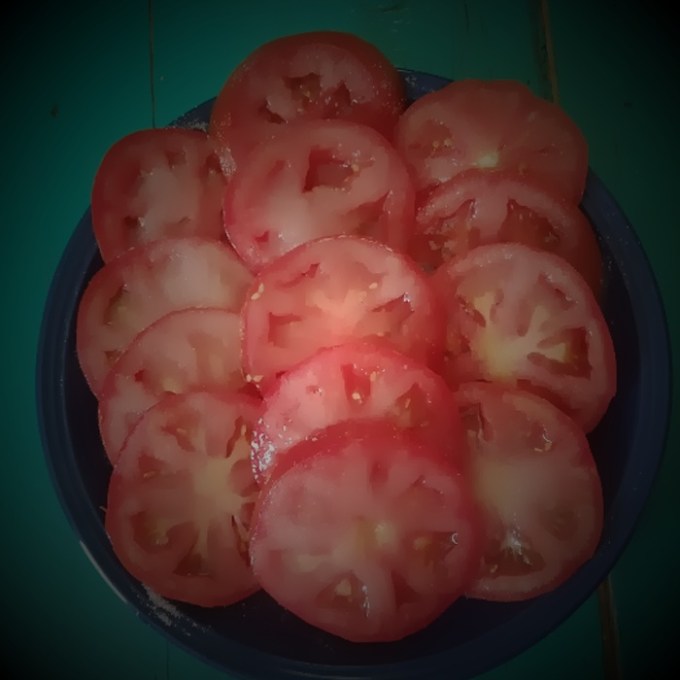
Everyone Likes Sugar on Their Tomatoes

Grandpa Pharis was a tall and slender man who, with the aid of his cane, stood very erect. His movements were careful and creaky. When he turned his focus to anything not right in front of him, his entire upper body, as if locked together, would slowly rotate. Nonetheless, he did not groan as he moved. He seemed essentially free of complaints.

His face was weathered and lined by the time I knew him. I think he was always serious. Only once I saw him on the verge of something that could have been a smile — if he had forced it.  I never heard him laugh.

Observing him, as grandchildren will do from an awed distance, I noticed he did not argue or offer disrespectful commentary in conversation with others. He did not interrupt people and appeared to wait patiently until they were finished. His responses, always brief, were offered then. He never cranked out woeful stories about how things were when he was a kid.

All these qualities set him apart. But the most remarkable trait was that he never spoke to me as if I was a child. I was a child, but he did not seem to think this changed anything for him. His tone was the same as he used with adults. Occasionally, he would use a word I did not understand. If I asked him to explain, he did so matter-of-factually.

But we all have our “things,” – judgments, baggage, assumptions — and I finally found one of his.

My family was having Sunday dinner and my grandfather was present. The fact that he was at our house was noteworthy. It hadn’t been long since my grandmother passed. When she was alive, they had stuck fast together at their home where I usually encountered him. With her gone, his children wrangled him out and about some.

This Sunday’s dinner fare was not uncommon: fried chicken, mashed potatoes, green beans and a basket of biscuits. But then – as a final act before seating herself — my mother brought over a large platter of sliced tomatoes and placed them right in front of Grandpa.  We had eaten tomatoes before, of course, but I had never seen such a heaping platter full. Equally puzzling, the platter was presented to Grandpa Pharis, as if it had the Thanksgiving turkey and he would be doing the honors of carving it.

He acknowledged the arrival of the platter with a nod. Then, Grandfather reached for the sugar bowl, took off the lid, and dusted the whole platter of tomatoes thick as a hard frost. Taking some for himself, he then passed the platter to his left. Everyone speared three or four slices and passed it on.

When it got to me, I just looked at the platter. I was perplexed. I had never seen or been offered such. Frankly, it looked disgusting.

I appealed directly to my Grandfather.  “Papa,” I said. “I don’t want sugar on my tomatoes.”  I was expecting him to give me a pass. I was disappointed.

Grandfather looked up sharply and drilled me with his eyes. With irritation in his voice, he said: “Boy, everybody likes sugar on their tomatoes.”

I was stunned. I blinked. I looked at the platter. It still looked pretty disgusting to me.

I looked over at my father to appeal my case, but that went nowhere. He just nodded his head and pointed toward the tomatoes with his fork. Now my father was fair and considerate about things, and he would usually not think a disliked food was something that a person should be forced to eat. Yet there he was, expecting me to do it. Essentially telling me I had to do it.

It was hopeless.  I forked a slice onto my plate, and I managed to eat that tomato, sugar and all.

Grandpa Pharis will never know it, but there really is at least one person who has no interest in having sugar on their tomatoes.

  • Note: Carlos made me wash the sugar off these before he would eat them. He is not kidding around. — Cyd Morgan, Photographer

Fifteen Cents

Tom’s Store was right on the edge of town, where the dirt roads ended and paving appeared. It was a fair trek on foot.  Looking back, it seems remarkable that my mother would let me traipse off that far by myself. But truly, the worst that could happen was that I might come across a rattle snake, and I knew how to be wary of such critters. Occasionally a car or truck would come down the dirt road, and invariably it would be someone I knew. I thought I was hiking off to New York City.

The only thing that cast anything close to a shadow on going to Tom’s Store was dealing with Tom himself.

Tom was tall and thin. His face was craggy, lined and leathery. His hair was dark, wavy, flecked with gray, and he combed it straight back. He always reminded me a little bit of what I thought Abraham Lincoln’s evil twin brother would have looked like if he had had one.

Tom never smiled, never laughed, and absolutely never participated in small talk with kids. I observed him interacting with adult customers in his store from time to time, and his expression softened as he exchanged bits of conversation. I had long concluded that Tom thought childhood was a waste of time and ought to be skipped altogether.

His dour attitude became exceptionally apparent if a youngster came up to the counter to pay for something and was even a penny or two short. Now, if your parents had called ahead and authorized the purchase Tom would just ‘write it on the wall,’ as they used to say. Your folks would take care of it later.

But if you were a sprout buying what was clearly kid stuff, like a cola or a chocolate bar, well, then if you came up short, you just came up short. Tom wasn’t writing anything on the wall. Your soda went back in the cooler and the candy bar returned to the shelf. That was the end of the story. Very humiliating. I’d seen him do it. Consequently, I never went into the store without being certain I had the money to cover my purchase.

It was a small store. When you walked in the door, the check-out counter, behind which Tom was always seated, was to your left. After coming through the door, you could either walk straight ahead down the aisle that presented in front of you, or turn left, walk toward Tom a few steps, and turn right to pass down the one double shelf that ran the length of the store. In addition to Tom, the coolers lined the far-left side of the store.

A lot of my buddies would go in and proceed straight down the aisle in front of them. They would go all the way to the end of the store and double back around to the cooler. They would pick up their soda and then present themselves to Tom to pay out. This meant they had to deal with being close to Tom only once.

I could understand this. There was something about being real close to Tom that was intimidating. You could feel the beam of his eyes on you the whole time you were in the store. The closer you got, the more his eyes kind of made your insides jiggle. But he seemed to give the kids who avoided him an extra fierce and disdainful gaze that I didn’t like. He would tilt his head ever so slightly to the right as he watched them cut a wide berth around him.

On the other hand, when I came through that door, turned left, went straight toward him, and then turned right in front of him, he wouldn’t tilt his head to the side. He would just look straight at me and nod ever so slightly as I went by. I’m not saying it wasn’t scary, but it felt a little better. More respectful.

One day I walked through the front just like usual. The little bell attached to the top of the door jingled out an alert. He looked up and, predictable as the rising sun, fixed his eyes on me as I approached. I met his gaze. He nodded.

The issue occupying my mind at that moment was whether to add a Dreamsicle to my intended purchase of an RC Cola. I finally decided that the RC was enough. I was going to amble over to the park after my stop at Tom’s. Toting along an ice cream bar in one hand and a soda in the other seemed a challenge to my main goal: to look cool.

I put my soda on the counter and went for my change to pay up. Tom didn’t say a word. He knew that I knew how much the soda was. I got my coins out and handed them to him. He said, “Thank ya,” and hit the keys on the old register. The door popped open and he dropped in the money.

Suddenly, I got focused on a dime and a nickel laying out there on the edge of the counter, a little off to the side and out of Tom’s view. Fifteen whole cents!  In 1958, that was an amount worthy of some note. I was frozen with indecision for a moment.

When Tom looked up from closing the cash register, I was still standing there. He seemed a little surprised. And just like that, I knew what to do. I pointed with my index finger toward the coins.

“There’s some money there,” I said. “It isn’t mine.”

Tom leaned forward a bit and looked at the coins. Then he looked back at me.

“See ya,” I said, turned and went out the door.

The next little while, whenever I came in Tom’s Store, things were just like they always were, and he was just like he always was. Our exchanges at the counter were sparse and direct.

Finally, a day arrived when, despite my caution about never coming into the store without the necessary funds, I did just that. I got to the counter with an RC Cola and Snickers bar, put the items on the counter, reached in my pocket, and instead of encountering metal, found nothing but the soft cotton of my jeans pocket. Quickly I reached over into my left-hand pocket. I knew that was no use though. I would never put money there. I also checked my two back pockets and the pocket on my t-shirt. Nothing. Now I could see the money lying on the top of my chest of drawers.

I took a sigh, and collected the soda and the chocolate bar to return them to stock. Tom had been watching me as I went through all this pocket grubbing. “Change your mind?” he asked as I pulled the items towards me.

“No. Don’t have my money. Left it on the dresser.”  I now had the soda in one hand and the Snickers in the other. I was a couple of paces from the counter headed back for the cooler and the candy case.

“Hold on there,” Tom commanded. I froze. “It’s pretty hot out there. You look a little wilted. Go ahead and take that soda. The candy too. Give you a little energy.”

I turned and stared at him dumbfounded. “But I don’t have any money with me,” I stammered.

“I heard you.” And he scowled a little. “You owe me 27 cents. Bring it by next time you come down the road.”