One Word

Jane Austen chose 160,993 words to create her novel Emma. My first thought was that it was a very thick book. I had not the slightest sense of wanting to dedicate a moment of my boyhood wading through such a tome. The Hardy Boys was more my style.

But, with no sense of what risk I was taking, I read the first sentence.

“Emma Woodhouse, handsome, clever, and rich, with a comfortable home and happy disposition, seemed to unite some of the best blessings of existence, and had lived nearly twenty-one years in the world with very little to distress or vex her.”

No sooner was I finished than I thought, “Wait, read that again.” I read it slowly and there it was — the phrase that had drawn me back. “…… seemed to unite some of the best blessings of existence……”

How could the list of blessings that had just been offered only seem to be something grand?

Miss Austen had snatched me as securely as any Hardy Boys or Nancy Drew mystery could have done. I was owned by the author from word 14. She had me for every word thereafter. She had me for every page. I was her prisoner, and she had done it with one word.

Kissing at the Caliche Pit

Becky Sue walked straight up to me on the playground. Without even a scratch of preamble she asked, “You want to go to the caliche pit after school and kiss?” 

To say I was surprised would understate the case dramatically. I didn’t know up to that moment a single word had ever passed between us. And it wasn’t just that this invitation was proffered by a near stranger. Kissing to that point in my life had never been high on my list of priorities. Truthfully, it had never been on any kind of list I had drawn up. 

Now there were all manner of female relatives I had kissed on the cheek as part of social protocol. I had kissed a young girl under the steps of Will Rogers Elementary when I was in the first grade. At least that is the report. I don’t have any memory of it. Nonetheless, it raised a great fuss among some of the family and all.  

My mind was not focused on kissing. I was obsessed with baseball. Thus, I astounded myself when I said “yes” to Becky Sue without hesitation. 

A word about the venue of this romantic encounter. The landscape on the Llano Estacado does not offer a lot of geographic opportunity for unobserved activity. Picture a large brown billiard table, say 37,000 square miles. There was certainly little to offer in terms of places to carry on covert activities nefarious, amorous or otherwise.  

That’s where the caliche pit came in. A geologist could explain this better, but here is something close to accurate. Caliche is a kind of rock that is useful in binding other stuff together, like gravel, sand, and clay. It has a lot of construction applications.  

There was a location pretty near the school where caliche had been dug out. What was left was just an immense hole. You could have parked a few school buses in the bottom with room to spare and you wouldn’t have seen them unless you were right up close to the pit. This pit had set there empty for a long time. Eventually the town would grow out that way, someone would buy the property, fill it in and build on it. But that day had not dawned. Around the edges of the pit desert shrubbery had taken a tenuous hold.   

So after school, Becky Sue walked me right to a spot where we could nestle up under and between two bushes. She seemed to know right where to go. I was glad. I had no clue as to how to proceed. 

We sat there a few minutes. Being protected from the sun meant a coolness settled down over us. 

Eventually I looked over at Becky Sue. Lord, I can see her yet. Dark, rich hair. Shiny green eyes. A beautiful smile.  

We leaned toward each other and I tried to perform what I thought was a kiss. We had trouble at this first attempt. First, I was a green novice right to the core. Second, a passel of leaves from a drooping limb got right there in the middle of our kiss. We both spit and laughed. Becky Sue took charge.  

We would have still been there today if she hadn’t eventually jumped up and said, “Got to get home!” She smiled and sped away, her feet flying. 

I sat there for a moment. “So, that’s what kissing is about,” I thought wondrously. 

When I walked in the back door of our place my Mother was clearly worried. “Where you been?” she barked. 

Like a fool, I instantly told the truth. “Been down at the Caliche Pit kissing with Becky Sue,” I reported and turned toward my room. 

She followed me down the hall. “My God!” she exclaimed. “Did anyone see you?” Her face was twisted up in a scowl, a picture of fear and anger. 

I wanted to report that I had not the least knowledge or concern about whether anyone had seen us, but a sense of self-preservation was dawning. “No!” I said with certainty. And I thought to myself, “Won’t be going down that trail again.” By that I meant reporting to Mother, not the part about kissing. 

Years later, when my son was born, I assume she concluded that some kissing had been involved.  But she never heard about it from me. 

© 2019 Carlos Declan Pharis 

Grandma Vinnie

grandma vinnie
This is us. There is a lot of hair under that hat, I swear.

I have a clear memory of my Grandmother Vinnie sitting at the dressing table in our guest bedroom, brushing her exceptionally long gray hair. It was fascinating to watch this process, and I did it almost every day when she visited.  After the brushing, she would go through the process of winding it up into a bun that set demurely on the top of her head. I was always astounded that hair that came all the way down to her waist could be tucked up into such a small package.

I no longer have a clear memory of how our game got started. It is simply there full grown in my mind. I would know it was coming, because instead of winding her hair up, she would rat it into a startling sight. Her hair became a huge bush that had suddenly been stuck into a light socket and the switch thrown. She would rise from her dressing table and slowly creep about with both hands out as if she were flying in slow motion.  She would stoop over and look up from under her bush of hair.

She would make this low noise, “Oooooooooooh” but it was not a long ‘o,’ it was more of a ‘u’ sound, like “youuuuuuuuuuuuuuuuuuuuuuuuu.” Then she would start to move slowly around as if she was coming to get me. I would shriek and flee, only to sneak back shortly, peering around a door frame or down the hall, waiting to see if she was going to find me.  Having affirmed the chase was afoot, I would giggle, scream, and run again. All of this would go on until I was exhausted. She would call the game to a halt, return to her dressing stool and transform from the Old Witch back in to my Grandmother.

One morning, the game had worked us around into the kitchen. I grabbed a broom by the bristles and poked playfully at the Old Witch. I wasn’t trying to hurt her at all. I knew we were playing. But then, in the process of making a poke, I slipped, lurched forward, and (happily, I suppose) missed my Grandmother.

KA-THUNK!

This brought us both up short. The broom handle had popped a right clean hole in the drywall. My grandmother and I stared at it for a moment.

“Well,” Grandmother said quietly, almost under her breath. She calculated. She looked at me. “You go get on with cleaning up your room and leave this to me.”

I slunk to my bedroom on trembling knees. I knew my Father was not going to see the hole in the wall as an event. My recent activity around the homestead had produced a dark view regarding my cavorting around in him. He was going to see the hole in the wall as a continuation of a spree of marginal juvenile delinquency that needed to be ended. I knew the end of days were descending on me. Grandmother cleaned up the crime scene and went about the activities of her day, but I stayed in my room, wrote my will, and reflected on my short life.

My Mother got home from work around five o’clock and my Father just moments afterwards.

Sure enough, the hole in the wall drew him like a tractor beam. He did not take time to read the paper, smoke a cigarette, or drink a cup of coffee. He came to my room and said, “The bathroom. Now.” I marched to the execution chamber mechanically, feeling like seven years of age was too young to receive the death penalty.

When we turned into the bathroom, we pulled up short. Grandmother was right there in the little room, standing quietly. We were both surprised and a little embarrassed. We were afraid we had caught her in the middle of something bathroom-ish.

“Come on in,” she said pleasantly. “I was just waiting on you two.”

My Father seemed confused. He stumbled over his words, trying to explain. I remember the big words, like “culprit,” “deserve” and “punishment.” He stepped aside and seemed to think she would walk on out so he could close the door and throttle the suds out of me.

She stood utterly still.

She looked at my Father and said, as best I can recall, “Bill, Little Bit poked that hole in the wall in the kitchen and surely some kind of response is due. But that means I need to stay, because whatever punishment is determined needs to be administered to me as well. I was playing with him. We created that hole in the wall together.”

My father was flummoxed, hooked on the horns of dilemma. He would not spank Grandmother Vinnie. That wasn’t even close to being on the table. But the notion of letting me off the hook wasn’t something he could embrace. I watched intently. I could feel him thinking.

When he finally looked at her again, she offered, “Perhaps if we fixed the wall and took efforts to make sure this doesn’t happen again?”

“Oh, I could fix the wall without any trouble at all,” Dad said with a touch of pride in his voice.

“I know you could,” she said, and patted his arm. “But that’s not the point. We did the damage,” she said with a nod in my direction, “and we need to fix it.”

He relented. And that quickly, she moved us past the issue of whether or how some kind of corporal punishment was going to take place. The angels sang! I almost did a jig. Of course, I was giving no thought to how tough it would be to fix that wall. I was too busy watching the execution chamber fading away.

Hammered Toe

At the time, I was a very small tyke, just walking and speaking. There was a uniform of the day I no doubt had on: a jumper that buttons up on the shoulders, maybe with a little t-shirt underneath. The sartorial package came with a cotton diaper and plastic wrapper that created a big bulge all around my bottom. It was completed with a pair of little white lace-up shoes that my mother polished freshly every day.

The eye-witness report of these events comes courtesy of my Grandmother Vinnie, who was there with us for one of her extended stays. She was sitting in the living room and watched the scene unfold.

My Dad entered the living room, intent on connecting with the newspaper and his cup of coffee. Upon sitting, he liked to get out of his shoes and into a pair of house slippers. Sometimes, especially in the summer, the house slippers did not get on for a while. They just sat there beside his feet while he drank his coffee and read the paper. Above all, he was not to be disturbed.

Enter me.

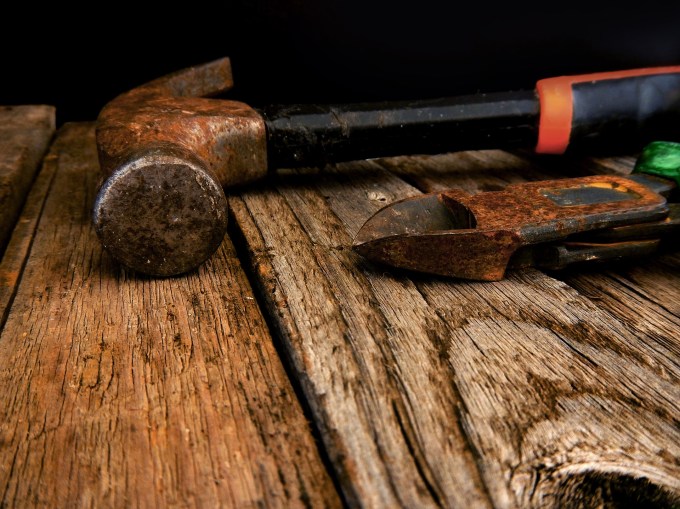
I acquired his hammer from where he had left it with all his other tools at the back door – a common place for him to drop them on his way in. Given that adults in my life only intervened on my activities if I was going to hurt myself, no one paid much attention to me dragging my Dad’s hammer about the place.

Eventually, I approached my Father, and announced rather matter-of-factly: “Daddy, I’m gonna hammer.”  To this piece of information, he responded with the kind of parental grunt given children when an audible response is called for but the energy or interest to get meaningfully involved is missing.

I looked around for something to hammer. With my one free hand, the other being used to hold my trusty tool, I patted my Father’s knee, disturbing his paper only the slightest. I asked with the kind of rational tone only a child can use when asking a completely bizarre question: “Can I hit your toe with this hammer?”

Now look, I don’t have a clue as to why, among all the things in the room I might have chosen to take a whack at, his toe represented to me the most likely candidate. A Freudian analyst would blather something about my sense that I had taken back seat to the news of Lea County and that I wanted to reassert my position as the only appropriate object of affection.  When I asked my Grandmother about it years later, she simply said: “Well, you know, little children do things like that.”

At any rate, it did register on my Father that a question had been posed to him.  He made one feeble attempt to join the conversation.  “What son?” he mumbled from behind his paper.

“Can I hit your toe with this hammer?” I repeated.

It is at this moment he made the error parents have been making in similar situations for years untold. Truthfully, he just wanted me to leave him alone, so he could go on reading the paper. His cup of coffee had been thoughtfully refilled by my Grandmother and he was fully engaged in the news. And so, he said, “Sure. Sure, son.”

I’m sure some of you are wondering why Grandmother didn’t intervene. I asked her myself. To her mind, the conversation between my father and me did not concern her in the least. The child was not in danger, and surely a man who had fought Hitler’s SS Units in Europe was not threatened to any great degree by a little boy barely able to walk, even if he was dragging a hammer behind him.

Having requested and been given permission to strike my Father’s toe with the hammer, I grasped it with my two chubby hands, lifted it, and let it go. Gravity did most of the work from there. And the head of that hammer hit his toe as precisely as my mother threading a sewing needle.

My Father bolted out of his chair like he had been shot with electricity. The coffee cup flew to his left and the paper rained down across the living room. He made loud and quite unintelligible sounds. (My mother seemed to have understood some of the words because I heard her later tell him he shouldn’t use such language in front of me.)  He hopped around a bit, which I thought was funny.

My Father did not think any of this was funny. When the pain subsided some and he got composed a bit, he made a grab for me. It was at this point my Grandmother concluded that she had a legitimate reason to be involved.

Grandmother leaned forward in her chair and said in an assertive voice: “Bill.” She had to repeat herself because my Father had a serious head of steam built up. “Bill!” she said again a little louder.

He stopped and looked straight at her. He had me dangling from one arm, with the offending hammer laying just out of my reach on the floor.  He gave my Grandmother direct attention.

“Bill,” she said, in a gentler tone now, “you told the boy he could do that.”

His gaze was incredulous.

“The child asked if he could hit your toe with that hammer.”  She pointed toward the carpentry implement that I was still eyeing.  “And you told him it was ok.”

“Well,” he blustered out and then let it trail off.  Finally, he said, “Well, Lord, I didn’t mean it.”

He let me back onto the floor. I sat down on my fully cushioned rump and began to handle the hammer with both hands.

My Father stepped away a couple of feet.  “I guess I wasn’t really listening to him.” He peered at Grandmother hopefully.  “I mean, did he really ask me?”

“I’m afraid so,” she said.  “I’m afraid so.”

The damage to his toe was not permanent, but the incident changed the way we communicated forever.  From then on, whenever I posed a question or wanted his attention in any way while he was having his alone time, the paper came down from his face immediately.

“Yes, Son?” he would say, and gaze at me intently.

Madrid New Mexico

The Windmill

The view was breathtaking. To the west was our little hardscrabble oil and ranching community. To the east was the vast expanse of the sourthern edge of the Llano Estacado. Above and all around was a luminous aqua sky dotted with white puffy clouds. The air was clean and light as a feather.

I was five years old. I had climbed up to the platform atop the windmill at the back of our property. I really don’t know how I managed this.

There was a two-lane paved road that led east in Texas. I could see it inch its way along until it seemed to over the edge of the earth. There was little traffic. I would occasionally see a car or two and sometimes a truck coming toward town or leaving. The vehicles looked like ants moving in their orderly and busy way.

Back toward town there was a black top road that ran toward me. The paving expired before it got to our place, finishing as a dirt road.

Eventually a particular vehicle caught my attention. It was still far away, but I could tell that it was Dad’s truck. It was coming my way.

Mild curiousity floated across my mind. What was he doing? Was he coming home? Why?

And then he was there. He turned onto our property, drove the short distance up the unpaved trace, parked and got out. He didn’t seem in any hurry, and he didn’t head into the house. As a matter of fact, he did what he did most times when he came home from work.

He ambled around the backyard, where he and my Mom were working to encourage grass to make a stand against the sand and weeds that thought the land belonged to them.

He took his pocketknife and dug up the roots of the big grass burrs that proliferated. He would walk around cutting these things out of the ground, holding them carefully in his left hand until he had a kind of grass burr bouquet. Then he would go over and deposit them in the trash can at the back of the property.

He would return to work until he had another collection in his hand. This would go on for 30 minutes or so. It was a kind of decompression ritual. When he was finished he would go inside where my Mom would meet him with a cup of coffee.

But that is what he did at the end of the day. Here we were, a long way before noon, and I was peering down watching him digging grass burrs just like he did in the evenings.

I was puzzled. I sat on the edge of the platform at the top of the windmill watching my Dad as he moved quietly and deliberately. This was very interesting because I had never seen this activity from such a height or perspective.

I didn’t call down to him, and he didn’t seem to know I was there. Eventually, though, he looked up at me. “Well, hi, Shorty,” he said, a bit surprised.

Then his head went bacck down and he went on with his work. My attention moved back and forth between my Dad and the broad vista around me. I was torn: I always wanted to be with my father, but the view was fantastic. I’d never seen anything like it.

Dad began to gather a little bit of trash and some twigs to add to the barrel where the grass burrs were being collected. From time-to-time he would burn all the refuse, and I would ‘help’ by going around the yard and picking up other miscellaneous items as he tended the fire.

When I realized where this process was going, I swung my leg over the platform onto the first rung and started down. A fire was the final incentive.

He seemed to hardly notice that I had climbed down the windmill. He just went about getting the fire started in the barrel. I started picking up random twigs, and an old brown paper sack that had blown into the yard.

Wordlessly, I walked up to heave the items into the fire. I waited for his go ahead as usual. Fire safety was an important lesson I had learned.

“Toss it in from over there,” he said, gesturing toward the north side of the barrel so that I would be up wind of the flames.

As I was doing this, he stepped over to the ladder that ran up the entire length of the windmill. He reached up, and with his hand struck the inside of the 1″x12″ that served as a rung. Off it came. He followed suit until all the steps on the ladder were gone up to the top of his head.

He took the pieces of wood that had served as rungs and stacked them together. He had dismantled the low end of the ladder discreetly but quickly. And tending to the fire was consuming my attention.

“We’ll let that fire die down. I just wanted those grass burrs to get burned up,” he said, gesturing toward the fire. “Let’s get a hammer and get these nails out of these boards. This is good wood. We can use it for something else.”

When we were finished, the wood was stacked neatly inside the shed. The nails we had removed were separated into two small piles. One pile contained the handful of nails that were straight enough or could be straightened for reuse. The others were set aside to be discarded altogether.

Sandstorm

I was sitting on the floor looking up at my mother. She was standing in front of the kitchen sink wringing out a wash rag from a pan of water. She bent down and started wiping my face, digging into my ears and nose with the cloth.

I pulled back a bit. She was sure tending to her cleaning chore with a lot of energy.

“Hold still,” she said. “You’ve got enough of the Llano Estacado in your nose and ears to grow a small garden. You wouldn’t want a tomato plant to start growing  out of your ear would you?”

“No, Momma, I wouldn’t,” I said, completely horrified by the thought.

I looked over her shoulder as she resumed working on me. We were in the middle of a sandstorm. The sun was high, but the sand was so thick the sun didn’t so much stream through the kitchen window as ooze through it. The light was a dull yellow. I could hear the wind whistling around the window and the sand pelting against the house.

The sand hung in tiny particles in the air in the kitchen. It was still inside the house and a bit stifling.

Satisfied that I was momentarily safe from being the breeding ground for vegetation, my Mom stepped back and rinsed out the rag. Then she bent down and folded the cloth over several times.

“I know it’s pretty close to wet,” she said. “But hold it over your mouth and nose and breath through it. It’ll keep the sand out of your lungs.”

She smiled and left me on the floor, returning to her work at the sink.

I held the cloth to my face and breathed through it. It did keep the sand out. It was cool and soothing.