Grandma Vinnie

grandma vinnie
This is us. There is a lot of hair under that hat, I swear.

I have a clear memory of my Grandmother Vinnie sitting at the dressing table in our guest bedroom, brushing her exceptionally long gray hair. It was fascinating to watch this process, and I did it almost every day when she visited.  After the brushing, she would go through the process of winding it up into a bun that set demurely on the top of her head. I was always astounded that hair that came all the way down to her waist could be tucked up into such a small package.

I no longer have a clear memory of how our game got started. It is simply there full grown in my mind. I would know it was coming, because instead of winding her hair up, she would rat it into a startling sight. Her hair became a huge bush that had suddenly been stuck into a light socket and the switch thrown. She would rise from her dressing table and slowly creep about with both hands out as if she were flying in slow motion.  She would stoop over and look up from under her bush of hair.

She would make this low noise, “Oooooooooooh” but it was not a long ‘o,’ it was more of a ‘u’ sound, like “youuuuuuuuuuuuuuuuuuuuuuuuu.” Then she would start to move slowly around as if she was coming to get me. I would shriek and flee, only to sneak back shortly, peering around a door frame or down the hall, waiting to see if she was going to find me.  Having affirmed the chase was afoot, I would giggle, scream, and run again. All of this would go on until I was exhausted. She would call the game to a halt, return to her dressing stool and transform from the Old Witch back in to my Grandmother.

One morning, the game had worked us around into the kitchen. I grabbed a broom by the bristles and poked playfully at the Old Witch. I wasn’t trying to hurt her at all. I knew we were playing. But then, in the process of making a poke, I slipped, lurched forward, and (happily, I suppose) missed my Grandmother.

KA-THUNK!

This brought us both up short. The broom handle had popped a right clean hole in the drywall. My grandmother and I stared at it for a moment.

“Well,” Grandmother said quietly, almost under her breath. She calculated. She looked at me. “You go get on with cleaning up your room and leave this to me.”

I slunk to my bedroom on trembling knees. I knew my Father was not going to see the hole in the wall as an event. My recent activity around the homestead had produced a dark view regarding my cavorting around in him. He was going to see the hole in the wall as a continuation of a spree of marginal juvenile delinquency that needed to be ended. I knew the end of days were descending on me. Grandmother cleaned up the crime scene and went about the activities of her day, but I stayed in my room, wrote my will, and reflected on my short life.

My Mother got home from work around five o’clock and my Father just moments afterwards.

Sure enough, the hole in the wall drew him like a tractor beam. He did not take time to read the paper, smoke a cigarette, or drink a cup of coffee. He came to my room and said, “The bathroom. Now.” I marched to the execution chamber mechanically, feeling like seven years of age was too young to receive the death penalty.

When we turned into the bathroom, we pulled up short. Grandmother was right there in the little room, standing quietly. We were both surprised and a little embarrassed. We were afraid we had caught her in the middle of something bathroom-ish.

“Come on in,” she said pleasantly. “I was just waiting on you two.”

My Father seemed confused. He stumbled over his words, trying to explain. I remember the big words, like “culprit,” “deserve” and “punishment.” He stepped aside and seemed to think she would walk on out so he could close the door and throttle the suds out of me.

She stood utterly still.

She looked at my Father and said, as best I can recall, “Bill, Little Bit poked that hole in the wall in the kitchen and surely some kind of response is due. But that means I need to stay, because whatever punishment is determined needs to be administered to me as well. I was playing with him. We created that hole in the wall together.”

My father was flummoxed, hooked on the horns of dilemma. He would not spank Grandmother Vinnie. That wasn’t even close to being on the table. But the notion of letting me off the hook wasn’t something he could embrace. I watched intently. I could feel him thinking.

When he finally looked at her again, she offered, “Perhaps if we fixed the wall and took efforts to make sure this doesn’t happen again?”

“Oh, I could fix the wall without any trouble at all,” Dad said with a touch of pride in his voice.

“I know you could,” she said, and patted his arm. “But that’s not the point. We did the damage,” she said with a nod in my direction, “and we need to fix it.”

He relented. And that quickly, she moved us past the issue of whether or how some kind of corporal punishment was going to take place. The angels sang! I almost did a jig. Of course, I was giving no thought to how tough it would be to fix that wall. I was too busy watching the execution chamber fading away.
Falling Rocks

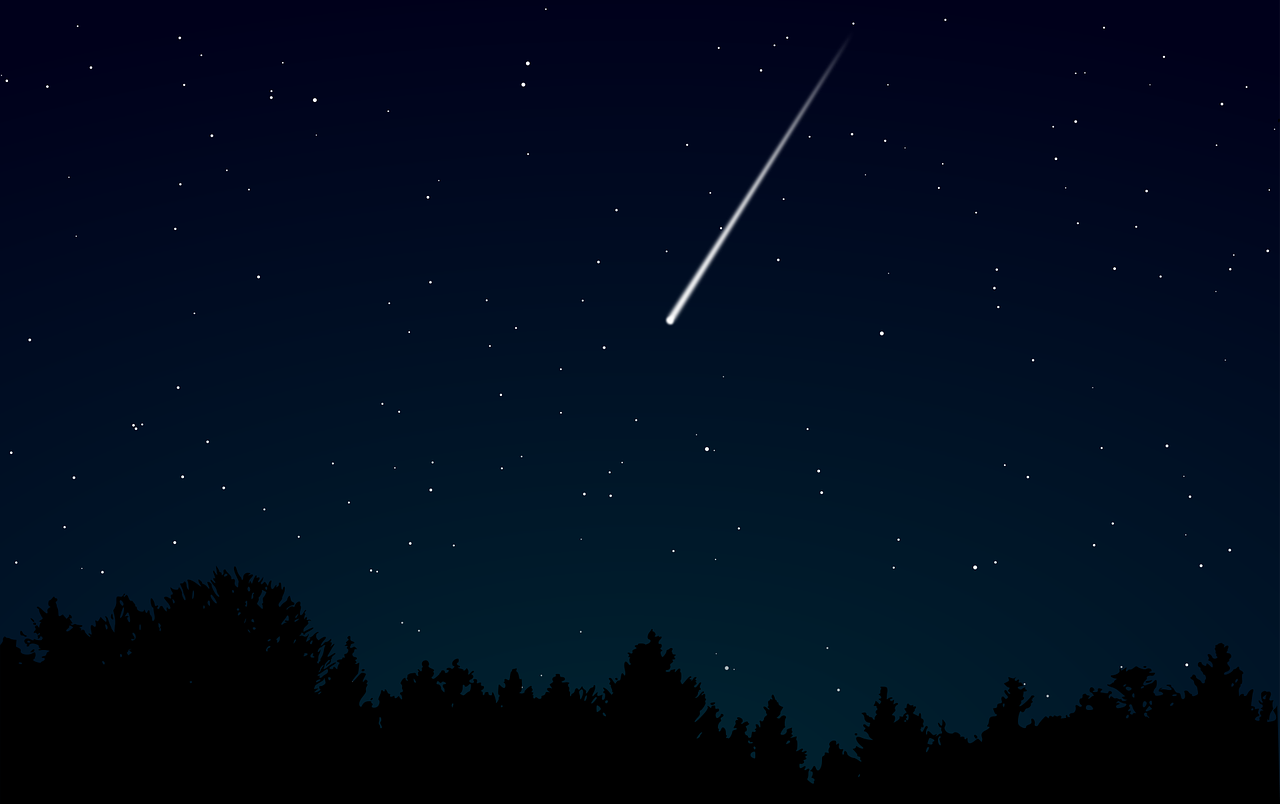
Meteor

As a boy, I spent my summers on a farm in Knox County, Texas belonging to my Uncle Charles and Aunt Gladys. There were many reasons I loved being there, but one of my favorite reasons was that we slept outside under the stars with some regularity. It was really hot in the summer, and the house never seemed to cool off. We slept in the yard to soak up enough coolness to be able to face the next day. It was practical.

For a boy like myself it was also an adventure. It was something different. It felt just a little dangerous out there in the wide open. And the stars were really, really pretty. Actually, I looked for almost any excuse to curl up outside.

Another reason I loved the farm was that my aunt and uncle subscribed to National Geographic. They saved back issues for me all year, and I loved digging through them. I would be engrossed in the wonderful maps for hours.

Of course, from time to time there would be an article about some faraway tribe replete with photographs featuring females who did not wear clothing covering the top half of their bodies. Of course, I took care that I was not seen examining these articles and attendant photographs. Of course, I always advertised that my sole interest in the periodical was the maps and the scientific content.

And it was true that I was fascinated with maps. And I did find the scientific content very interesting.

But I had committed an outright act of dishonesty by denying any knowledge of the semi-nude photographs. Lying and lusting. I knew I had an express ticket to hell. I had no intention of repenting. Really, I was going to hell.

This particular summer, I was perusing my favorite magazine when it was suddenly there in black and white. I read the words again to see if I had it right. Yep.  I had. It was true. It was a warning from National Geographic, and we all know this is a periodical to take seriously.

Apparently, the possibility existed that a person somewhere on the planet could actually get killed by a piece of meteorite that failed to burn up in the atmosphere. The odds were infinitesimally small. I mean, just barely in the range of possibility. But that’s all it took for me. I was off to the psychiatric races.

The article made it clear that I would not hear it coming and I may not be safe unless maybe I was in the bottom of Carlsbad Caverns. Basically, I could be just minding my own business and with no hint of warning an errant piece of rock could shoot down out of the sky faster than a freight train and kill me deader than dirt. There seemed to be no escape.

A few weeks later, Uncle Charles declared it a night for sleeping outside. All of the bedding was prepared and they were settling down when he asked where I was. I could hear him through the open window to my room, and I froze. I had been planning  on staying inside.

Aunt Gladys reported that I was not coming outside because I was afraid I would get hit by a meteor.

Uncle Charles, a farmer and engineer, a WWII veteran, intelligent and practical, pondered for a moment.  “Well that is kind of silly,” he said. “That roof wouldn’t even slow a meteor down.”

“Charles Amos,” Gladys hissed. “Really. You know how he is!” And I could hear that she was making for the house to check on me.

I was beyond horrified. I was about to panic. I gathered up my pillow and blanket. We met at the door. She saw me, my eyes wild. She stopped, held the door and let me pass.  I went straight to the cellar in the backyard we used for shelter from tornadoes.  It is where I slept for most of the rest of the summer.

I was going to hell for lying and lusting, and now I was certain the tool God was going to use was a confounded meteor.  But I wasn’t going to make it easy.

Everyone Likes Sugar on Their Tomatoes

Grandpa Pharis was a tall and slender man who, with the aid of his cane, stood very erect. His movements were careful and creaky. When he turned his focus to anything not right in front of him, his entire upper body, as if locked together, would slowly rotate. Nonetheless, he did not groan as he moved. He seemed essentially free of complaints.

His face was weathered and lined by the time I knew him. I think he was always serious. Only once I saw him on the verge of something that could have been a smile — if he had forced it.  I never heard him laugh.

Observing him, as grandchildren will do from an awed distance, I noticed he did not argue or offer disrespectful commentary in conversation with others. He did not interrupt people and appeared to wait patiently until they were finished. His responses, always brief, were offered then. He never cranked out woeful stories about how things were when he was a kid.

All these qualities set him apart. But the most remarkable trait was that he never spoke to me as if I was a child. I was a child, but he did not seem to think this changed anything for him. His tone was the same as he used with adults. Occasionally, he would use a word I did not understand. If I asked him to explain, he did so matter-of-factually.

But we all have our “things,” – judgments, baggage, assumptions — and I finally found one of his.

My family was having Sunday dinner and my grandfather was present. The fact that he was at our house was noteworthy. It hadn’t been long since my grandmother passed. When she was alive, they had stuck fast together at their home where I usually encountered him. With her gone, his children wrangled him out and about some.

This Sunday’s dinner fare was not uncommon: fried chicken, mashed potatoes, green beans and a basket of biscuits. But then – as a final act before seating herself — my mother brought over a large platter of sliced tomatoes and placed them right in front of Grandpa.  We had eaten tomatoes before, of course, but I had never seen such a heaping platter full. Equally puzzling, the platter was presented to Grandpa Pharis, as if it had the Thanksgiving turkey and he would be doing the honors of carving it.

He acknowledged the arrival of the platter with a nod. Then, Grandfather reached for the sugar bowl, took off the lid, and dusted the whole platter of tomatoes thick as a hard frost. Taking some for himself, he then passed the platter to his left. Everyone speared three or four slices and passed it on.

When it got to me, I just looked at the platter. I was perplexed. I had never seen or been offered such. Frankly, it looked disgusting.

I appealed directly to my Grandfather.  “Papa,” I said. “I don’t want sugar on my tomatoes.”  I was expecting him to give me a pass. I was disappointed.

Grandfather looked up sharply and drilled me with his eyes. With irritation in his voice, he said: “Boy, everybody likes sugar on their tomatoes.”

I was stunned. I blinked. I looked at the platter. It still looked pretty disgusting to me.

I looked over at my father to appeal my case, but that went nowhere. He just nodded his head and pointed toward the tomatoes with his fork. Now my father was fair and considerate about things, and he would usually not think a disliked food was something that a person should be forced to eat. Yet there he was, expecting me to do it. Essentially telling me I had to do it.

It was hopeless.  I forked a slice onto my plate, and I managed to eat that tomato, sugar and all.

Grandpa Pharis will never know it, but there really is at least one person who has no interest in having sugar on their tomatoes.

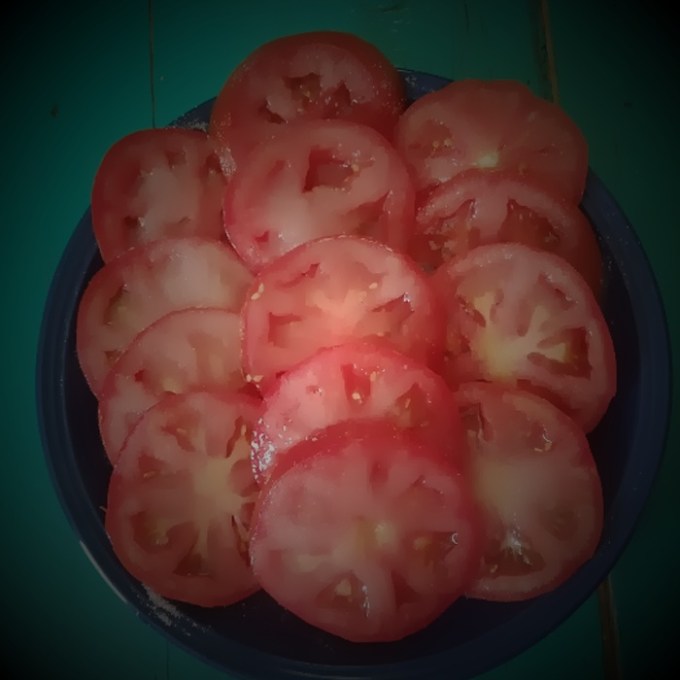
  • Note: Carlos made me wash the sugar off these before he would eat them. He is not kidding around. — Cyd Morgan, Photographer
Madrid New Mexico

The Windmill

The view was breathtaking. To the west was our little hardscrabble oil and ranching community. To the east was the vast expanse of the sourthern edge of the Llano Estacado. Above and all around was a luminous aqua sky dotted with white puffy clouds. The air was clean and light as a feather.

I was five years old. I had climbed up to the platform atop the windmill at the back of our property. I really don’t know how I managed this.

There was a two-lane paved road that led east in Texas. I could see it inch its way along until it seemed to over the edge of the earth. There was little traffic. I would occasionally see a car or two and sometimes a truck coming toward town or leaving. The vehicles looked like ants moving in their orderly and busy way.

Back toward town there was a black top road that ran toward me. The paving expired before it got to our place, finishing as a dirt road.

Eventually a particular vehicle caught my attention. It was still far away, but I could tell that it was Dad’s truck. It was coming my way.

Mild curiousity floated across my mind. What was he doing? Was he coming home? Why?

And then he was there. He turned onto our property, drove the short distance up the unpaved trace, parked and got out. He didn’t seem in any hurry, and he didn’t head into the house. As a matter of fact, he did what he did most times when he came home from work.

He ambled around the backyard, where he and my Mom were working to encourage grass to make a stand against the sand and weeds that thought the land belonged to them.

He took his pocketknife and dug up the roots of the big grass burrs that proliferated. He would walk around cutting these things out of the ground, holding them carefully in his left hand until he had a kind of grass burr bouquet. Then he would go over and deposit them in the trash can at the back of the property.

He would return to work until he had another collection in his hand. This would go on for 30 minutes or so. It was a kind of decompression ritual. When he was finished he would go inside where my Mom would meet him with a cup of coffee.

But that is what he did at the end of the day. Here we were, a long way before noon, and I was peering down watching him digging grass burrs just like he did in the evenings.

I was puzzled. I sat on the edge of the platform at the top of the windmill watching my Dad as he moved quietly and deliberately. This was very interesting because I had never seen this activity from such a height or perspective.

I didn’t call down to him, and he didn’t seem to know I was there. Eventually, though, he looked up at me. “Well, hi, Shorty,” he said, a bit surprised.

Then his head went bacck down and he went on with his work. My attention moved back and forth between my Dad and the broad vista around me. I was torn: I always wanted to be with my father, but the view was fantastic. I’d never seen anything like it.

Dad began to gather a little bit of trash and some twigs to add to the barrel where the grass burrs were being collected. From time-to-time he would burn all the refuse, and I would ‘help’ by going around the yard and picking up other miscellaneous items as he tended the fire.

When I realized where this process was going, I swung my leg over the platform onto the first rung and started down. A fire was the final incentive.

He seemed to hardly notice that I had climbed down the windmill. He just went about getting the fire started in the barrel. I started picking up random twigs, and an old brown paper sack that had blown into the yard.

Wordlessly, I walked up to heave the items into the fire. I waited for his go ahead as usual. Fire safety was an important lesson I had learned.

“Toss it in from over there,” he said, gesturing toward the north side of the barrel so that I would be up wind of the flames.

As I was doing this, he stepped over to the ladder that ran up the entire length of the windmill. He reached up, and with his hand struck the inside of the 1″x12″ that served as a rung. Off it came. He followed suit until all the steps on the ladder were gone up to the top of his head.

He took the pieces of wood that had served as rungs and stacked them together. He had dismantled the low end of the ladder discreetly but quickly. And tending to the fire was consuming my attention.

“We’ll let that fire die down. I just wanted those grass burrs to get burned up,” he said, gesturing toward the fire. “Let’s get a hammer and get these nails out of these boards. This is good wood. We can use it for something else.”

When we were finished, the wood was stacked neatly inside the shed. The nails we had removed were separated into two small piles. One pile contained the handful of nails that were straight enough or could be straightened for reuse. The others were set aside to be discarded altogether.