At the time, I was a very small tyke, just walking and speaking. There was a uniform of the day I no doubt had on: a jumper that buttons up on the shoulders, maybe with a little t-shirt underneath. The sartorial package came with a cotton diaper and plastic wrapper that created a big bulge all around my bottom. It was completed with a pair of little white lace-up shoes that my mother polished freshly every day.
The eye-witness report of these events comes courtesy of my Grandmother Vinnie, who was there with us for one of her extended stays. She was sitting in the living room and watched the scene unfold.
My Dad entered the living room, intent on connecting with the newspaper and his cup of coffee. Upon sitting, he liked to get out of his shoes and into a pair of house slippers. Sometimes, especially in the summer, the house slippers did not get on for a while. They just sat there beside his feet while he drank his coffee and read the paper. Above all, he was not to be disturbed.
Enter me.
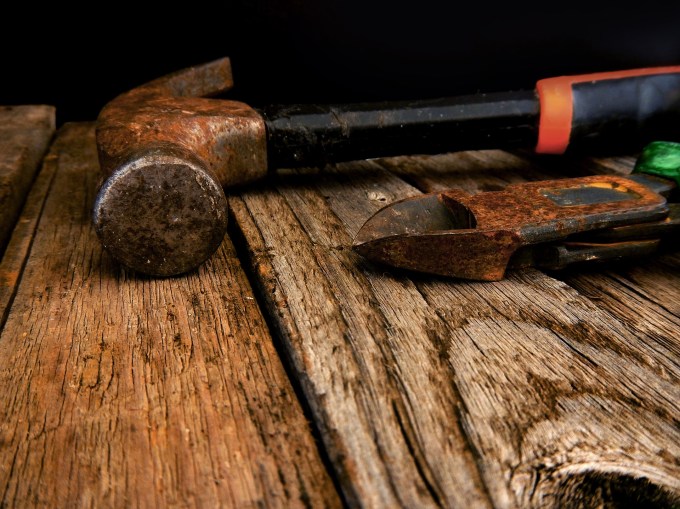
I acquired his hammer from where he had left it with all his other tools at the back door – a common place for him to drop them on his way in. Given that adults in my life only intervened on my activities if I was going to hurt myself, no one paid much attention to me dragging my Dad’s hammer about the place.
Eventually, I approached my Father, and announced rather matter-of-factly: “Daddy, I’m gonna hammer.” To this piece of information, he responded with the kind of parental grunt given children when an audible response is called for but the energy or interest to get meaningfully involved is missing.
I looked around for something to hammer. With my one free hand, the other being used to hold my trusty tool, I patted my Father’s knee, disturbing his paper only the slightest. I asked with the kind of rational tone only a child can use when asking a completely bizarre question: “Can I hit your toe with this hammer?”
Now look, I don’t have a clue as to why, among all the things in the room I might have chosen to take a whack at, his toe represented to me the most likely candidate. A Freudian analyst would blather something about my sense that I had taken back seat to the news of Lea County and that I wanted to reassert my position as the only appropriate object of affection. When I asked my Grandmother about it years later, she simply said: “Well, you know, little children do things like that.”
At any rate, it did register on my Father that a question had been posed to him. He made one feeble attempt to join the conversation. “What son?” he mumbled from behind his paper.
“Can I hit your toe with this hammer?” I repeated.
It is at this moment he made the error parents have been making in similar situations for years untold. Truthfully, he just wanted me to leave him alone, so he could go on reading the paper. His cup of coffee had been thoughtfully refilled by my Grandmother and he was fully engaged in the news. And so, he said, “Sure. Sure, son.”
I’m sure some of you are wondering why Grandmother didn’t intervene. I asked her myself. To her mind, the conversation between my father and me did not concern her in the least. The child was not in danger, and surely a man who had fought Hitler’s SS Units in Europe was not threatened to any great degree by a little boy barely able to walk, even if he was dragging a hammer behind him.
Having requested and been given permission to strike my Father’s toe with the hammer, I grasped it with my two chubby hands, lifted it, and let it go. Gravity did most of the work from there. And the head of that hammer hit his toe as precisely as my mother threading a sewing needle.
My Father bolted out of his chair like he had been shot with electricity. The coffee cup flew to his left and the paper rained down across the living room. He made loud and quite unintelligible sounds. (My mother seemed to have understood some of the words because I heard her later tell him he shouldn’t use such language in front of me.) He hopped around a bit, which I thought was funny.
My Father did not think any of this was funny. When the pain subsided some and he got composed a bit, he made a grab for me. It was at this point my Grandmother concluded that she had a legitimate reason to be involved.
Grandmother leaned forward in her chair and said in an assertive voice: “Bill.” She had to repeat herself because my Father had a serious head of steam built up. “Bill!” she said again a little louder.
He stopped and looked straight at her. He had me dangling from one arm, with the offending hammer laying just out of my reach on the floor. He gave my Grandmother direct attention.
“Bill,” she said, in a gentler tone now, “you told the boy he could do that.”
His gaze was incredulous.
“The child asked if he could hit your toe with that hammer.” She pointed toward the carpentry implement that I was still eyeing. “And you told him it was ok.”
“Well,” he blustered out and then let it trail off. Finally, he said, “Well, Lord, I didn’t mean it.”
He let me back onto the floor. I sat down on my fully cushioned rump and began to handle the hammer with both hands.
My Father stepped away a couple of feet. “I guess I wasn’t really listening to him.” He peered at Grandmother hopefully. “I mean, did he really ask me?”
“I’m afraid so,” she said. “I’m afraid so.”
The damage to his toe was not permanent, but the incident changed the way we communicated forever. From then on, whenever I posed a question or wanted his attention in any way while he was having his alone time, the paper came down from his face immediately.
“Yes, Son?” he would say, and gaze at me intently.
 Carlos Declan Pharis